Early childhood learning is often evaluated through visible outcomes. Parents frequently look for signs such as early reading, advanced counting, or accelerated academic progress.
While these milestones may appear impressive, they are not the most reliable indicators of long-term learning success.
What matters more during early childhood is the development of consistent learning habits.
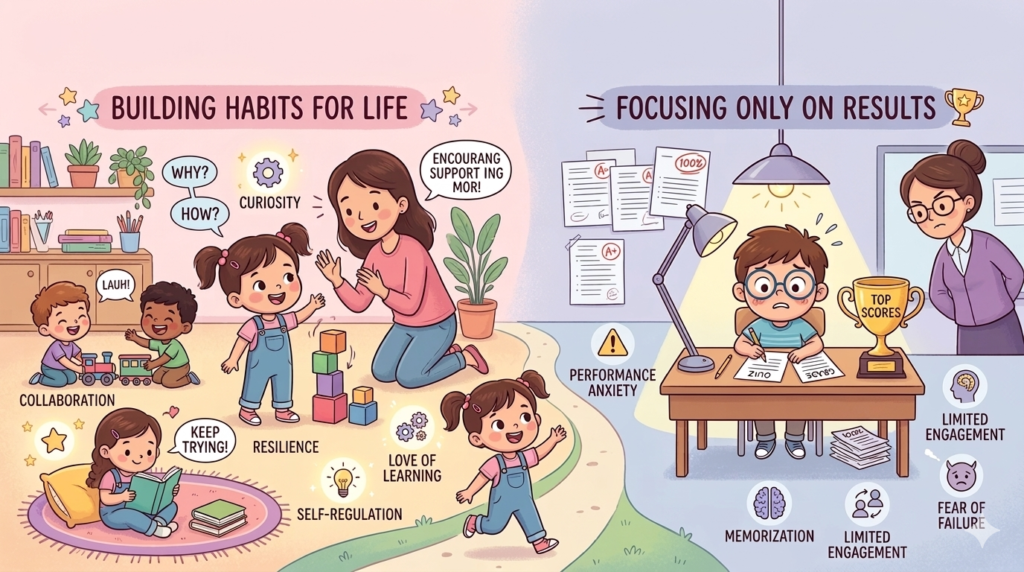
Early Results Can Be Misleading
Children develop at different rates. Some acquire academic skills earlier due to exposure, interest, or developmental timing.
However, early academic performance does not necessarily predict later academic strength.
A child who reads early may not automatically become a stronger learner in later years. Likewise, a child who develops academic skills more gradually may eventually demonstrate stronger learning stability.
Short-term performance often reflects opportunity rather than long-term capability.
The Role of Learning Habits
Learning habits form the behavioral foundation that supports academic growth over time.
Examples include:
- Sitting with a task for a reasonable period
- Listening carefully to instructions
- Attempting challenges before asking for help
- Returning to incomplete work
- Accepting small mistakes during learning
These behaviors shape how a child approaches learning situations repeatedly.
Over time, habits influence effort, persistence, confidence, and the development of concentration skills.
Why Habits Develop More Slowly Than Skills
Academic skills can sometimes appear quickly once a child understands a concept.
Habits, however, develop through repeated experiences.
A child gradually learns to:
- Remain engaged during structured activities
- Manage small frustrations
- Follow a simple routine
- Complete tasks even when interest decreases
This process requires time and consistency.
Because habits develop gradually, they are sometimes overlooked when parents focus primarily on visible academic outcomes.
The Risk of Focusing Too Early on Academic Performance
When early education becomes heavily focused on results, several unintended patterns may emerge:
- Children may become overly dependent on guidance
- Mistakes may feel threatening rather than instructional, especially when children have not yet learned handling mistakes without losing confidence.
- Learning may become associated with pressure rather than curiosity
These patterns can interfere with the gradual development of independence and persistence.
A more balanced approach places equal value on effort, engagement, and routine.
How Parents Can Support Strong Learning Habits
Parents do not need complex systems to encourage healthy learning habits.
Several consistent practices are often sufficient:
- Establish predictable learning routines.
- Encourage children to attempt tasks before receiving help.
- Allow small mistakes to occur during practice.
- Keep learning activities manageable in length.
- Reinforce completion rather than speed.
These practices create a stable environment in which habits can develop naturally.
Long-Term Benefits of Habit Formation
Children who develop strong learning habits early often demonstrate:
- Greater persistence during difficult tasks
- Increased confidence when approaching unfamiliar material
- More consistent attention during learning activities
- Greater readiness for independent work in later years
Habits provide the behavioral structure that allows academic skills to expand gradually.
These early habits later support the development of academic independence.
A Balanced Perspective on Early Learning
Early childhood learning does not need to be accelerated to be effective.
What matters most is the establishment of stable learning behaviors.
When habits such as focus, persistence, and engagement develop early, academic progress tends to follow more smoothly over time.
Early results may appear impressive in the moment.
Learning habits determine what remains sustainable.