Many adults separate play from learning.
Play is often seen as recreation, while learning is associated with structured instruction.
For young children, however, this distinction rarely exists.
Play is one of the most natural and powerful ways through which early learning occurs. Through playful exploration, children test ideas, repeat experiences, and gradually build understanding.
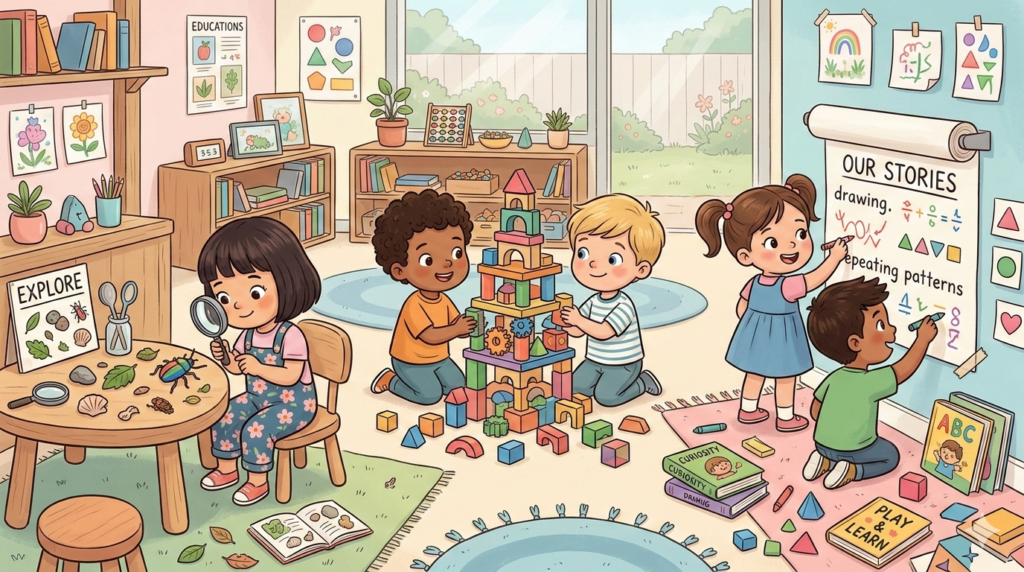
Rather than distracting from learning, play often provides the environment where learning develops most effectively.
Play Encourages Curiosity
Children are naturally curious about the world around them.
During play, they experiment freely with objects, movements, and ideas. This exploration allows them to ask questions, observe outcomes, and adjust their behavior.
In this way, play becomes an expression of curiosity, which is one of the strongest drivers of sustained learning in childhood.
When children are allowed to explore through play, they engage more deeply with their environment.
Play Naturally Creates Repetition
Another important feature of play is repetition.
Children often repeat the same activity many times: stacking blocks, building structures, or revisiting familiar games.
While this repetition may appear unnecessary to adults, it serves an important learning function.
Through repeated experiences, children strengthen memory, refine their understanding, and gain confidence in their abilities.
In this sense, play provides a natural setting where repetition strengthens learning without requiring formal instruction.
Play Strengthens Attention
Playful activities also support the gradual development of attention.
When children are engaged in an activity they enjoy, they often remain focused for longer periods. This sustained engagement helps build the early capacity for attention that later supports structured learning.
Because play is self-directed, children tend to remain involved voluntarily rather than through external pressure.
This makes play an effective way to strengthen early engagement with learning tasks.
Play Encourages Problem Solving
During play, children regularly encounter small challenges.
A tower falls over.
A puzzle piece does not fit.
A rule in a game needs adjustment.
These moments encourage children to test solutions, reconsider strategies, and persist with the activity.
Over time, these experiences strengthen confidence and flexibility when facing learning challenges.
The Balance Between Play and Structure
This does not mean structured learning has no role.
As children grow older, structured instruction becomes increasingly important. Reading, writing, and mathematics require focused practice.
However, in early childhood, learning often develops most effectively when play remains a central part of daily activities.
Play supports exploration, repetition, and engagement – all of which contribute to the development of stable learning habits.
These experiences gradually contribute to the formation of early learning habits.
Supporting Play as Part of Learning
Parents can support learning through play in simple ways:
- Provide opportunities for open-ended play.
- Allow children to repeat activities they enjoy.
- Avoid interrupting play too quickly.
- Observe how children explore and experiment.
These small adjustments create an environment where learning can develop naturally.
A Foundation for Later Learning
Play may appear simple on the surface, but it supports several key aspects of early learning.
Through playful exploration, children develop curiosity, strengthen attention, and build the habits that support later academic learning.
When play is respected as a meaningful part of development, it becomes one of the strongest foundations for lifelong learning.