Children do not learn every new idea in isolation. Much of what they understand develops through connections between new information and things they have already experienced, observed, or learned.
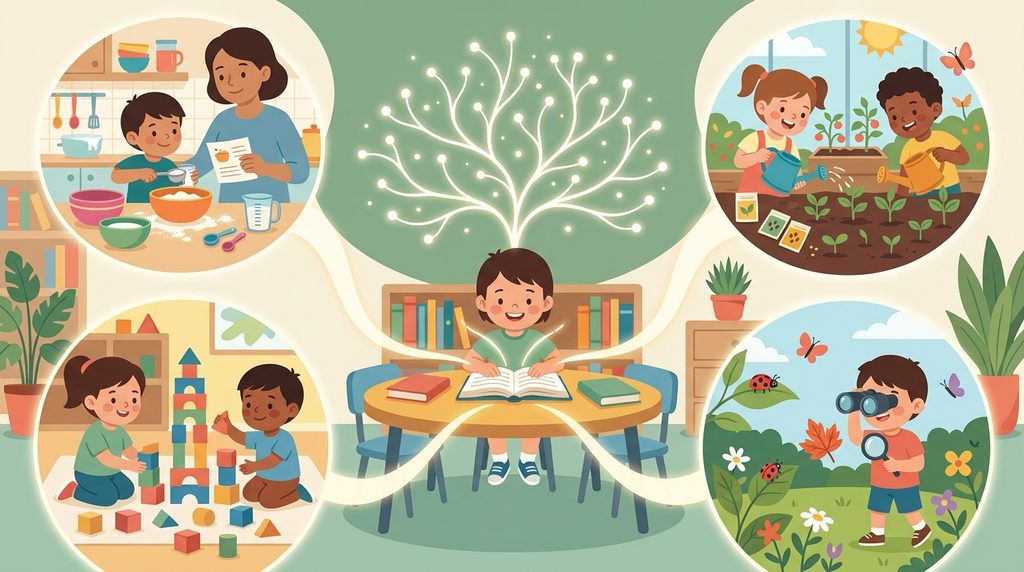
For example, a child who has helped prepare food may find it easier to understand measurements in a mathematics lesson. A child who has watched plants grow may have a useful starting point when learning about the needs of living things.
These connections help children make sense of unfamiliar information.
However, children do not always recognise how a new lesson relates to something they already know. They may memorise new facts without understanding how those facts fit with their existing knowledge.
Parents can help by encouraging children to notice connections, recall relevant experiences, and explain how different ideas relate to one another.
Why Connecting New Information Matters
When children connect new information to existing knowledge, they have something familiar to use as a starting point.
This can make unfamiliar ideas easier to understand.
Imagine a child learning about multiplication for the first time. If they already understand repeated addition, they can use that familiar idea to make sense of multiplication.
Instead of treating multiplication as an entirely new rule, they begin to see how it relates to something they already understand.
These connections can help children:
- Understand unfamiliar ideas more easily.
- Remember information more meaningfully.
- Recognise relationships between different topics.
- Explain concepts in their own words.
- Build a stronger foundation for future learning.
The goal is not simply to help children remember more information. It is to help them understand how different pieces of knowledge fit together.
Why Children Sometimes Struggle to Make Connections
Some children can learn new information but find it difficult to connect it with what they already know.
There are several reasons this can happen.
They Treat Each Lesson as a Separate Topic
Children may see mathematics, science, reading, and everyday experiences as completely separate areas.
They might learn about measurement in school without recognising that they use measurement when cooking or comparing the sizes of objects at home.
The connection may seem obvious to an adult, but children often need help recognising it.
They Have Not Fully Understood the Earlier Concept
A child may be introduced to a new idea that depends on previous knowledge they have not yet mastered.
For example, understanding fractions becomes more difficult if the child is still uncertain about dividing quantities into equal parts.
When the earlier concept is unclear, the new information may feel disconnected or confusing.
In these situations, revisiting the relevant foundation can be more useful than moving straight into another explanation.
They Remember Facts Without Understanding Their Meaning
A child may remember a definition or repeat information from a lesson without understanding how it relates to other ideas.
For example, they might remember that plants need water and sunlight but struggle to explain why a plant kept in a dark cupboard does not grow well.
Remembering the information is a starting point. Children also need opportunities to think about what it means and how it relates to what they have observed.
They Do Not Know Which Previous Knowledge Is Relevant
Children may have useful experiences and information but not recognise when those experiences can help them understand something new.
They may know how to compare prices when shopping but fail to connect that experience with a mathematics lesson about comparing numbers.
Parents can help by drawing attention to these relationships without immediately explaining everything.
How Parents Can Help Children Make Connections
Parents do not need special teaching materials to encourage this skill. Everyday conversations and familiar activities can provide useful opportunities.
Begin With What the Child Already Knows
Before introducing an unfamiliar idea, ask the child what they already know about the subject.
For example, before discussing how plants grow, you might ask:
- Have you noticed how plants change over time?
- What do you think plants need to grow?
- Have you ever helped water a plant?
- What happens when a plant does not receive enough water?
These questions help children recall relevant experiences.
They also give parents a better understanding of what the child already knows and where additional explanation may be needed.
Connect New Lessons to Everyday Experiences
Children often understand an idea more easily when they can relate it to something familiar.
For example:
- Connect fractions with sharing food or dividing objects equally.
- Connect measurement with cooking, building, or comparing household items.
- Connect reading comprehension with conversations about stories, films, or everyday events.
- Connect science lessons with observations of weather, plants, animals, and the environment.
The purpose is not to turn every family activity into a formal lesson.
Instead, help children notice when something they are learning is connected to an experience they already understand.
Ask Questions That Reveal Relationships
Rather than simply telling children that two ideas are connected, encourage them to identify the relationship.
You might ask:
- Does this remind you of something you have learned before?
- What is similar about these two examples?
- How is this different from what we discussed earlier?
- Can you think of a situation where you have seen something like this?
- How does the earlier idea help you understand this one?
Give children time to think before offering an explanation.
They may not identify the connection immediately. That is part of the learning process.
Encourage Children to Explain the Connection
Once a child identifies a relationship, ask them to explain it in their own words.
For example, if they recognise that multiplication is related to repeated addition, ask them to explain how the two methods are connected.
This helps parents see whether the child understands the relationship or has simply recognised a familiar word or example.
Do not expect a perfect explanation. The aim is to encourage the child to organise their thoughts and describe what they understand.
Revisit Earlier Learning
Connections become easier to recognise when children have opportunities to revisit previous knowledge.
A short conversation about an earlier lesson can help prepare them for a new topic.
For example, before learning about the water cycle, you might discuss what the child already knows about rain, evaporation, clouds, and puddles.
This gives the new information a familiar starting point.
Revisiting earlier learning does not mean repeating an entire lesson. A few well-chosen questions may be enough to bring relevant knowledge back into the child’s thinking.
Use Similarities and Differences to Deepen Understanding
Making connections is not only about identifying what two ideas have in common. Children also need to recognise how ideas differ.
For example, a child learning about squares and rectangles may initially focus on their similarities. Both have four sides and four corners.
However, they also need to understand the features that distinguish one shape from another.
Parents can encourage this thinking by asking:
- What is the same about these two things?
- What is different?
- Why do you think they belong to the same group?
- What feature makes them different?
This approach can be used in many subjects.
Children can compare characters in stories, examine differences between living and non-living things, or identify similarities between mathematical methods.
Comparing ideas helps children develop a clearer understanding of the information they are learning.
What to Do When a Child Cannot Make the Connection
If a child struggles to connect new information with previous knowledge, avoid assuming that they have not been paying attention.
First, identify which part is causing difficulty.
Consider these questions:
- Does the child understand the new information?
- Do they remember the earlier concept?
- Can they explain the earlier concept in their own words?
- Do they recognise how the two ideas might be related?
If the child has forgotten the earlier concept, revisit it briefly.
If they understand both ideas separately but cannot see the relationship, provide a familiar example that makes the connection easier to recognise.
If they are still confused, simplify the explanation and introduce one connection at a time.
Avoid presenting too many related ideas together. Children need time to understand each relationship before moving on.
Common Mistakes Parents Should Avoid
A few well-intentioned approaches can make it harder for children to develop this skill.
Making the connection for the child every time
Explaining every relationship immediately may prevent children from practising how to identify connections themselves. Ask a question first and give them time to think.
Assuming familiar experiences are automatically understood
A child may have helped with cooking or shopping without understanding the mathematical ideas involved. Help them notice the connection rather than assuming it is obvious.
Introducing too many new ideas at once
Trying to connect several topics in one conversation can overwhelm a child. Focus on one useful relationship at a time.
Moving forward before checking earlier understanding
New learning often depends on previous knowledge. If the foundation is unclear, revisit it before introducing more complicated ideas.
Turning every conversation into a lesson
Children also need time to explore, play, and experience everyday activities naturally. Look for genuine opportunities to make connections rather than forcing an educational question into every situation.
Conclusion
Children develop deeper understanding when they can connect new information with what they already know.
These connections help them make sense of unfamiliar ideas, recognise relationships between topics, and build knowledge over time.
Parents can support this development by starting with familiar experiences, asking thoughtful questions, revisiting earlier learning, and encouraging children to explain how different ideas are related.
The aim is not to provide every connection for the child. It is to help them gradually recognise those relationships for themselves.
As children become better at connecting ideas, they develop a stronger foundation for understanding more complex concepts and approaching unfamiliar learning with greater confidence.
Recommended Next Step
Once children begin connecting new information with what they already know, the next challenge is learning how to use that knowledge when facing unfamiliar tasks.
Read When a Child Understands a Concept but Cannot Apply It to explore how children move from understanding an idea to using it in different situations.