Children do not become independent learners simply because they are given more responsibility.
They first need to learn how to decide what they want to improve, what they need to do, and how they will know they are making progress.
This is where learning goals become important.
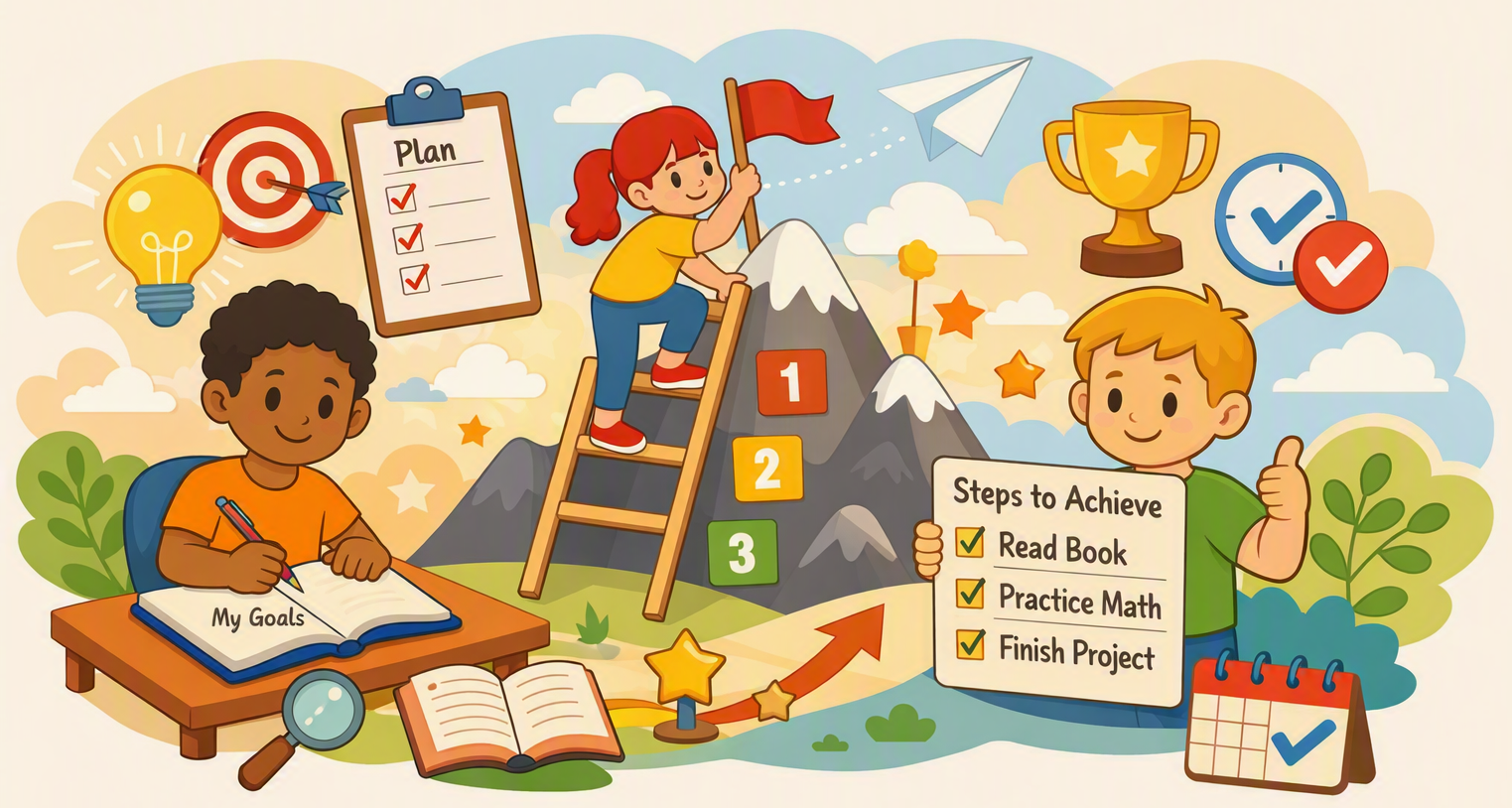
A learning goal gives a child a clear target. Instead of simply being told to “study maths” or “read more,” a child gradually learns to identify a specific area they want to work on.
Parents can help children develop this skill without turning learning into a system of pressure, rewards, or constant performance measurement.
The aim is to help children become more aware of their own learning and gradually take ownership of it.
What Is a Learning Goal?
A learning goal is a simple statement about something a child wants or needs to improve.
For example:
- “I want to get better at multiplication.”
- “I want to read longer without losing focus.”
- “I want to learn how to spell these words.”
- “I want to understand fractions.”
- “I want to write a better introduction.”
A useful learning goal focuses on learning or improving a skill, rather than simply getting a particular result.
For example:
“I want to understand how fractions work.”
is more useful for learning than:
“I want to get 90% on my next test.”
The second goal focuses mainly on the result. The first focuses on the learning itself.
Why Children Need Help Learning to Set Goals
Young children are not always able to identify what they need to improve.
They may know that something feels difficult without knowing exactly why.
A child might say:
“I am bad at maths.”
But the actual problem may be much more specific. Perhaps the child understands addition and subtraction but struggles to remember multiplication facts.
Learning to set goals helps children move from a general feeling of difficulty toward a specific learning need.
Instead of:
“Maths is hard.”
they can gradually learn to think:
“I need more practice with multiplication facts.”
That is a much more useful starting point.
Start With Goals Parents Help Create
Children do not need to set completely independent goals immediately.
At first, parents can help them identify a suitable target.
For example:
Parent: “You seem comfortable with addition now. What would you like to become better at next?”
Child: “Multiplication.”
Parent: “Which part of multiplication?”
Child: “The 6 and 7 times tables.”
The parent has not simply assigned a target. They have helped the child think about their own learning.
Over time, the parent can reduce this support.
Move From Parent-Set Goals to Child-Set Goals
Children can gradually move through different levels of responsibility.
Stage 1: Parent chooses the goal
The parent identifies what the child should work on.
Stage 2: Parent and child choose together
The parent provides guidance while the child helps select the target.
Stage 3: Child chooses with guidance
The child identifies an area they want to improve and discusses whether the goal is realistic.
Stage 4: Child sets the goal independently
The child can identify a learning need, choose a reasonable target, and decide what action to take.
This progression matters.
Giving a child complete responsibility before they have developed the necessary skills can simply create confusion.
Independence should be built gradually. This gradual approach is also important when helping children develop broader learning independence, as discussed in article on How to Build Learning Independence in Children (Without Pressure).
Help Children Make Goals Specific
A goal such as:
“I want to get better at reading.”
is a reasonable starting point, but it is still quite broad.
Parents can help make it more specific.
For example:
“I want to read for 15 minutes without giving up when I reach a difficult word.”
Or:
“I want to learn five new vocabulary words this week and use them in sentences.”
Specific goals give children something they can actually work on.
They also make progress easier to notice. Making goals specific also works alongside the planning and time-management skills children need as they become more academically independent. See article Why Planning and Time Management Skills Are Essential for Academic Independence.
Keep Goals Small Enough to Act On
Large goals can become overwhelming.
A child may say:
“I want to become really good at maths.”
There is nothing wrong with the ambition, but it does not tell the child what to do today.
A smaller goal might be:
“I will practise multiplication facts for 10 minutes and check which ones I still find difficult.”
This gives the child a clear action.
Large improvements are usually built from smaller steps.
This connects with the skill of breaking difficult tasks into manageable parts, which children also need to develop as they become more independent learners.
Let Children Think About Why the Goal Matters
A child is more likely to understand a goal when they can explain why it matters.
Parents can ask simple questions such as:
- “Why would you like to improve this?”
- “What would become easier if you learned this?”
- “What part do you find difficult?”
- “What would you like to be able to do by the end?”
- “How will you know you are improving?”
These questions encourage children to think about their own learning rather than simply following instructions.
Goals Should Not Become Pressure
Learning goals are useful, but they can become counterproductive when parents turn them into constant performance targets.
Avoid making every goal about:
- grades
- rankings
- beating other children
- avoiding mistakes
- pleasing parents
- completing a fixed amount of work regardless of understanding
A child who does not reach a goal exactly as planned has not necessarily failed.
The goal may have been too difficult, the method may not have worked, or the child may have discovered that they need more time.
The useful question is:
“What did you learn from working toward the goal?”
That keeps the focus on learning.
Teach Children to Review Their Goals
Setting a goal is only the beginning.
Children also need to learn to look back at their progress.
After working on a goal, ask:
- “What improved?”
- “What is still difficult?”
- “What helped you?”
- “What did not help?”
- “Do you need more practice?”
- “Should we change the goal?”
This develops an important connection between goal setting and self-monitoring.
A child gradually learns that learning is not simply:
Set task → complete task → move on.
It becomes:
Choose a goal → work on it → check progress → adjust → continue.
That is a much stronger foundation for independent learning.
Give Children Some Choice
Children do not need complete freedom, but they should have meaningful choices where appropriate.
For example, instead of saying:
“You must practise spelling for 20 minutes.”
a parent might say:
“Would you rather practise these words by writing them, reading them aloud, or using them in sentences?”
The learning objective remains clear, while the child has some control over how to approach it.
This can help children see themselves as active participants in their learning rather than people who simply receive instructions.
Common Mistakes Parents Make
Making goals too large
“Become better at maths” is difficult to act on.
Break it into a smaller skill.
Choosing every goal for the child
Parents naturally want to help, but children also need opportunities to make decisions about their own learning.
Making every goal about results
Grades and scores can provide useful information, but they should not become the only measure of progress.
Changing goals too quickly
Children need enough time to practise and see whether an approach is working.
Treating an unfinished goal as failure
Sometimes an unfinished goal provides useful information about what the child needs next.
Signs a Child Is Developing Goal-Setting Skills
You may notice that your child begins to:
- identify areas they want to improve
- describe specific learning difficulties
- suggest what they could practise
- choose realistic targets
- explain why a goal matters
- monitor their own progress
- change their approach when something is not working
- ask for help when they cannot make progress independently
These are signs of developing learning independence.
The goal is not for a child to create perfect goals.
The goal is for the child to become increasingly capable of thinking about their own learning and deciding what to do next.
Final Thoughts
Children need more than knowledge to become independent learners.
They also need to understand how to direct their own learning.
Learning to set goals gives children a practical way to begin developing that ability.
Parents can start by helping children identify small, realistic goals. As children become more capable, parents can gradually step back and allow them to choose, monitor, and adjust their own goals.
Over time, this can help a child move from:
“What do I have to do?”
toward:
“What do I need to learn, and what should I do next?”
That shift is an important part of becoming an independent learner.