Introduction
Questions are one of the clearest signs that learning is taking place.
Some children naturally ask lots of questions, while others stay quiet even when they are curious. Many parents wonder how to encourage children to ask questions without making them feel pressured or embarrassed. Helping children feel safe to ask questions is one of the most effective ways to support long-term learning.
When children ask questions, they are trying to understand, connect ideas, and make sense of new information. Yet many children gradually become less willing to ask questions, especially when they worry about giving the wrong answer or appearing less capable than others.
Over time, this hesitation can slow learning. Children who remain confused are less likely to build confidence, solve problems independently, or develop deeper understanding.
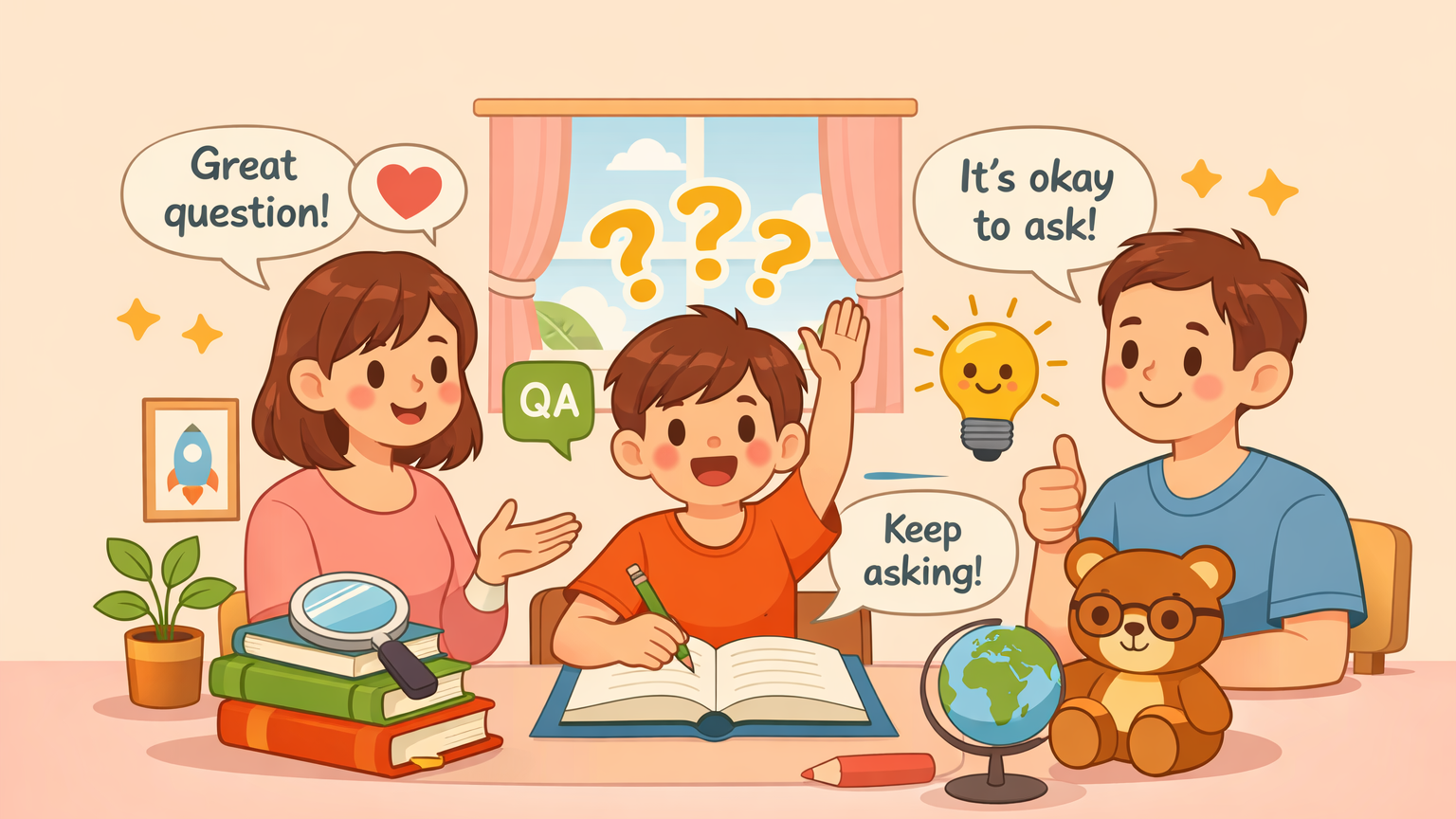
Encouraging children to ask questions helps nurture curiosity and supports deeper learning. Parents often look for ways to encourage kids to ask questions because these conversations build confidence, independence, and long-term learning habits.
Why Some Children Stop Asking Questions
Children are naturally curious.
However, several experiences can reduce their willingness to speak up.
Common reasons include:
- fear of making mistakes
- worrying that the question is “silly”
- being corrected too quickly
- comparing themselves with others
- feeling rushed during learning
In many cases, silence does not mean understanding. It simply means the child has chosen not to express uncertainty.
Children who fear making mistakes may also begin avoiding more challenging learning situations, making it helpful to understand why some children avoid difficult tasks.
Why Asking Questions Matters
Questions help children:
- clarify confusion
- connect new ideas with existing knowledge
- strengthen memory
- develop problem-solving skills
- become more independent learners
Children who feel comfortable asking questions are often better prepared to work through future learning challenges.
Asking questions appropriately is an important step toward becoming an independent learner, because children learn to seek understanding rather than waiting for answers.
Signs Your Child May Be Hiding Confusion
A child does not always say, “I don’t understand.”
Instead, you may notice behaviours such as:
- agreeing without confidence
- avoiding eye contact
- changing the subject
- copying others without understanding
- giving up quickly
- becoming unusually quiet during learning
Recognising these signs allows parents to respond before frustration develops.
How Parents Can Encourage Questions
1. Respond Calmly
When children ask questions, avoid reacting with frustration or impatience.
A calm response shows that asking for clarification is a normal part of learning.
2. Value the Question, Not Just the Answer
Instead of focusing only on getting the correct answer, acknowledge the child’s willingness to ask.
This reinforces curiosity rather than perfection.
3. Allow Thinking Time
Children sometimes need time to organise their thoughts before speaking.
Avoid answering immediately or finishing sentences for them.
A short pause often gives children the confidence to express their own ideas.
4. Admit That Adults Do Not Know Everything
Parents do not need to have every answer.
Saying, “Let’s find out together,” demonstrates that learning continues throughout life and that uncertainty is normal.
5. Avoid Turning Every Question Into a Test
If every question is followed by another question or correction, children may become reluctant to speak.
Sometimes they simply need an explanation.
When Children Pretend to Understand
Some children nod, say “okay,” or continue working even though they remain confused.
This usually happens because they want to avoid embarrassment or disappointment.
Helping children recognise that confusion is a normal stage of learning reduces this pressure and makes future questions more likely.
Common Mistakes to Avoid
Dismissing Simple Questions
Questions that seem obvious to adults may represent an important learning step for a child.
Expecting Immediate Understanding
Children often need repeated explanations before new ideas become clear.
Patience supports deeper learning.
Comparing Children
Statements such as “Your brother understood this immediately” discourage questions and increase anxiety.
Learning develops at different rates for different children.
Conclusion
Children learn best when they feel safe to be curious.
Questions should be viewed as evidence of engagement rather than signs of weakness.
Feeling comfortable asking questions is one of the behaviours that contributes to stronger learning habits over time.
By responding calmly, allowing time to think, and treating uncertainty as a natural part of learning, parents help children build confidence, independence, and deeper understanding.
The goal is not to encourage more questions for their own sake.
The goal is to help children feel confident enough to ask when they genuinely need understanding.