Independence in learning is a goal many parents have, but it is often misunderstood in practice.
Some parents stay heavily involved for too long, while others step back too quickly. Both approaches make it harder for children to develop real independence.
Learning independence does not happen automatically, and it cannot be forced. It develops gradually through the right balance of support and responsibility.
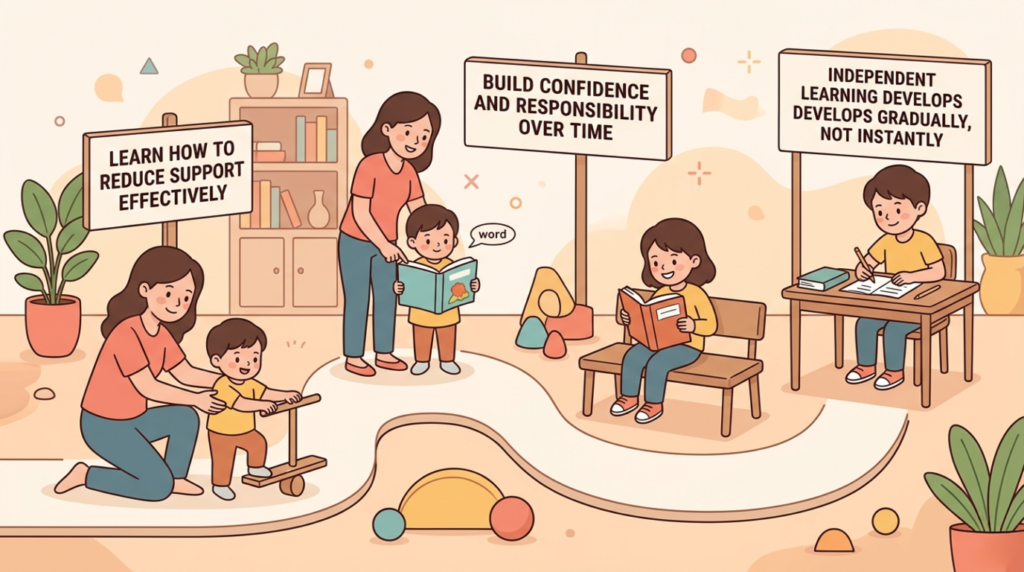
To build independence effectively, it helps to understand how support should change over time.
The Transition From Support to Independence
Children do not become independent just because they are told to “study on your own.”
Independence fails to develop when:
- parents provide too much help, solving problems too quickly
- support is removed before the child is ready
- learning lacks structure or consistency
In these situations, children either become dependent on constant guidance or feel overwhelmed when left alone.
Independence is not a single step. It is a progression.
A more effective approach is to move through stages:
→ Full Support
→ Guided Support
→ Partial Independence
→ Full Independence
Each stage serves a purpose.
1. Full Support
At the beginning, children need clear guidance.
This may include:
- explaining tasks
- helping them get started
- staying nearby during learning
At this stage, the goal is not independence. It is understanding and familiarity.
2. Guided Support
Once the child is more comfortable, support should begin to change.
Instead of doing things for them:
- ask questions instead of giving answers
- guide their thinking
- allow them to attempt before stepping in
This helps the child stay engaged while still feeling supported.
3. Partial Independence
At this stage, the child begins to take more responsibility.
This may include:
- completing tasks alone
- checking their own work
- managing short study periods independently
Support is still available, but not constant.
4. Full Independence
Eventually, the child is able to:
- start tasks without prompting
- work through challenges with minimal help
- manage their own learning routines
This stage develops over time. It is not immediate.
Independence develops more effectively when parents understand when to help your child and when to step back rather than trying to withdraw support all at once.
Practical Examples
Homework
Instead of sitting through the entire session:
- begin by helping them understand the task
- then step away for short periods
- return only when the child is clearly stuck or requests help
Problem Solving
When a child struggles:
- avoid giving the answer immediately
- ask: “What do you think you should try next?”
- allow time for thinking
Study Routines
Encourage the child to:
- follow a consistent study time
- complete tasks before seeking help
This builds responsibility gradually.
Encouraging your child to follow a consistent study schedule becomes easier when you stay consistent with home learning, as predictability reduces resistance and builds responsibility over time.
Common Mistakes to Avoid
1. Stepping Back Too Early
Expecting independence before the child is ready leads to:
- frustration
- avoidance
- loss of confidence
2. Staying Involved for Too Long
Constant supervision can lead to:
- dependence
- lack of initiative
- reduced problem-solving ability
3. Expecting Immediate Change
Independence develops through repeated experience, not quick fixes.
How This Connects to Other Learning Areas
Independence does not develop in isolation. It is built through consistent patterns of behavior and support.
For example, children who follow predictable routines find it easier to take responsibility for their learning. Likewise, when parents gradually adjust their level of involvement, children begin to take initiative on their own.
Over time, this leads to the development of task initiation, where a child starts work without prompting, and consistent study habits, which reduce the need for supervision.
Without these supporting skills, independence is difficult to maintain.
One clear sign of progress is when a child begins , starting their work without needing repeated prompts.
Conclusion
Helping a child become an independent learner is not about stepping away completely.
It is about knowing how to reduce support gradually while maintaining structure.
When this balance is managed well:
- children gain confidence
- take ownership of their learning
- develop long-term academic skills
As children begin to take more responsibility for their learning, they gradually develop consistent study habits that reduce the need for constant reminders.
Independence is not something you demand from a child.
It is something you build through consistent support, gradual responsibility, and time.