Many parents wonder how much a child should study at home and whether they are doing enough to support their child’s learning.
Some worry that their child is not doing enough, while others are concerned about pushing too hard. This often leads to confusion, especially when advice focuses on increasing study time rather than understanding what is appropriate.
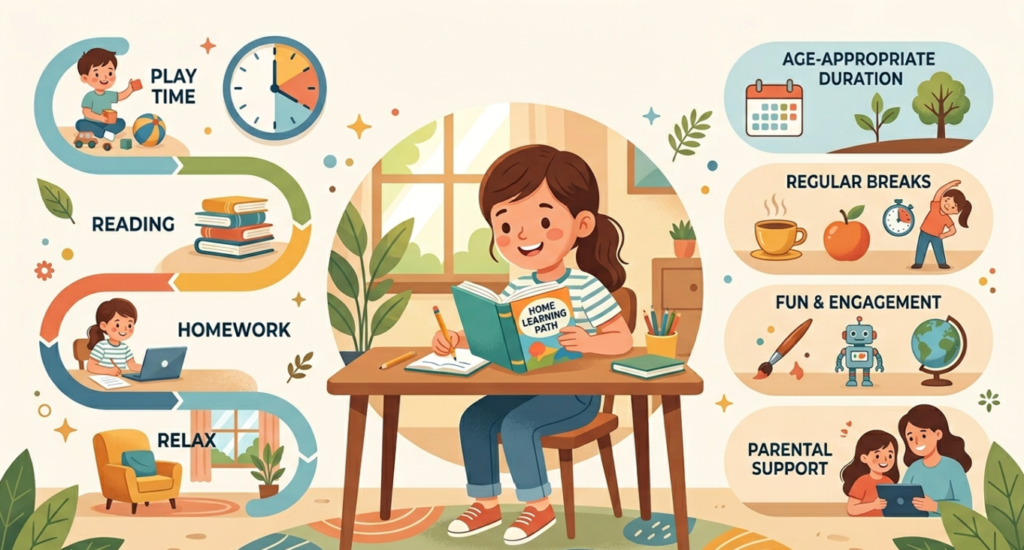
The reality is that there is no single “correct” number of hours. What matters more is whether learning is consistent, manageable, and suited to the child’s stage of development.
Why Study Time Alone Is Not the Answer
It is common to assume that more study time leads to better learning. In practice, this is not always true.
Long study sessions can lead to:
- reduced focus
- frustration
- resistance toward learning
Short, consistent sessions are often more effective, especially for younger children. Learning improves when children can stay engaged, not when they are required to sit for extended periods.
Rather than focusing only on time, it is more useful to consider how learning fits into daily routines and how well a child responds to it.
How Much Should a Child Study? (By Age)
The following guidelines are general and should be adjusted based on the child’s needs, attention span, and school demands.
Ages 4–6
- 10–20 minutes per day
- Focus on reading, basic numbers, and simple activities
- Learning should feel light and engaging
At this stage, play-based learning and conversation are just as important as structured study.
Ages 7–9
- 20–30 minutes per day
- Begin simple independent tasks
- Introduce basic routines
Children can handle slightly more structure, but still benefit from short sessions and variety.
Ages 10–12
- 30–45 minutes per day
- More focus on school-related work
- Encourage responsibility for completing tasks
At this stage, children begin to manage learning with less direct supervision.
Ages 13+
- 45–90 minutes depending on workload
- Focus on subject-based study
- Develop planning and time management
Study time may increase, but it should still be balanced with rest and other activities.
Signs Study Time Is Too Much or Too Little
Instead of relying only on time, it is more effective to observe how a child responds to learning.
Signs It May Be Too Much
- frequent frustration or stress
- resistance to starting tasks
- declining focus during study time
Signs It May Be Too Little
- lack of familiarity with basic concepts
- difficulty keeping up with schoolwork
- inconsistent learning habits
If you are unsure whether your child is getting enough learning overall, it helps to look at broader patterns rather than just study time. A more complete way to evaluate this is explained in How to Know If Your Child Is Getting Enough Learning at Home.
Focus on Consistency Over Duration
Consistency has a greater impact than duration.
A short daily session is more effective than long sessions done irregularly. When learning becomes part of a predictable routine, children are more likely to stay engaged and make steady progress.
This also reduces the need for constant reminders and helps children develop a more natural approach to learning.
Balancing Support and Independence
As children grow, the role of parents should gradually change.
Too much involvement can create dependence, while too little support can lead to confusion and avoidance. The goal is to adjust support over time so that children begin to take more responsibility for their learning.
Understanding how to balance this is an important part of building long-term learning independence. A practical approach to this is explained in How to Build Learning Independence in Children.
What Matters More Than Time
When asking how much a child should study, it is important to look beyond time alone.
Instead of asking “How long should my child study?”, a more useful question is:
- Is learning happening consistently?
- Is the child able to stay engaged?
- Is independence gradually developing?
When these elements are present, study time becomes less of a concern.
Conclusion
There is no fixed number of hours that defines effective home learning.
The right amount of study time depends on the child’s age, needs, and ability to stay engaged. Short, consistent sessions are often more effective than longer, inconsistent ones.
When learning is balanced, manageable, and supported appropriately, it becomes easier for children to stay motivated and continue developing over time.
Recommended Next Step
If you are unsure whether your child’s learning is balanced overall, the next step is to understand how to evaluate learning beyond time alone.
→ How to Know If Your Child Is Getting Enough Learning at Home