A child may spend a long time sitting at a desk without actually learning effectively.
In many homes, increased study time is treated as the solution to academic difficulty. When children struggle, the response is often to extend study sessions, add more practice, or increase supervision.
While this approach may appear productive, it frequently creates resistance instead of improvement.
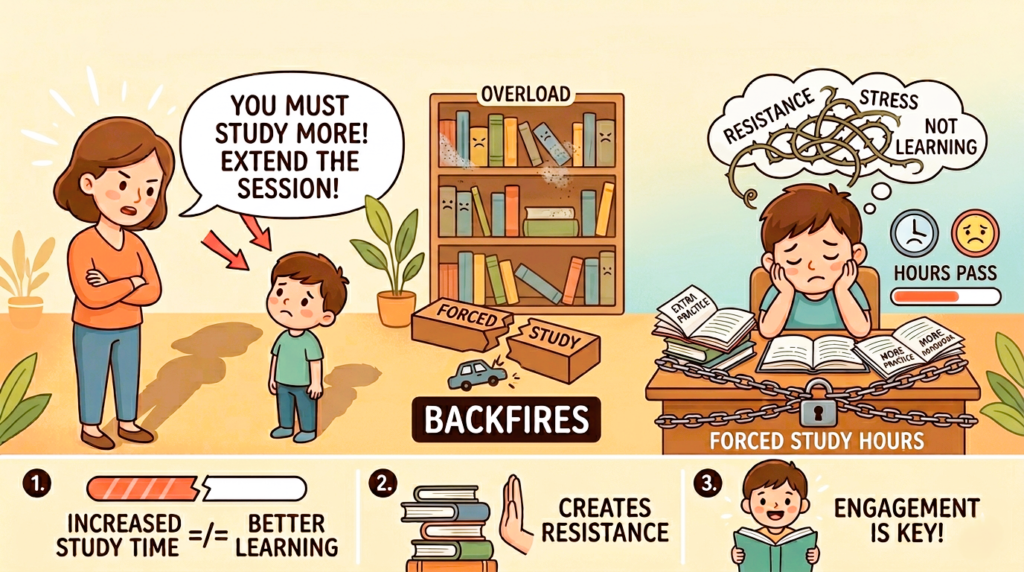
More study time does not automatically lead to better learning.
Why Parents Increase Study Time
Parents usually increase study time with good intentions.
Common reasons include:
- concern about academic progress
- inconsistent performance
- unfinished work
- fear that the child is “falling behind”
The problem is not the intention. The problem is assuming that more time automatically improves learning quality.
What Happens When Study Is Forced
When study time becomes excessive or overly controlled, several problems begin to appear.
1. Resistance Increases
Children begin to associate learning with pressure rather than progress.
This often leads to:
- avoidance
- frustration
- delay in starting tasks
2. Focus Declines
Long study sessions reduce attention and mental energy.
After a certain point, children may continue sitting, but concentration becomes weak.
This creates the appearance of studying without meaningful engagement.
3. Dependence on Supervision Grows
Constant monitoring can prevent children from developing responsibility for their own learning.
Instead of learning how to manage tasks independently, they begin relying on reminders and pressure.
Why Shorter, Consistent Study Often Works Better
Learning improves more through consistency than intensity.
Shorter study sessions are usually:
- easier to sustain
- easier to focus through
- less emotionally exhausting
This creates a more stable learning pattern over time.
A structured approach to creating manageable study sessions is explained in How to Structure a Study Session That Your Child Can Follow Consistently.
The Difference Between Productive Effort and Forced Effort
Productive effort occurs when the child is:
- engaged
- mentally present
- able to work with manageable challenge
Forced effort occurs when the child is:
- overwhelmed
- mentally fatigued
- studying mainly to avoid pressure
These two situations may look similar externally, but they produce very different results.
What Helps Instead
Rather than increasing pressure, it is usually more effective to improve structure.
Helpful adjustments include:
- reducing study session length
- creating clearer starting points
- using predictable routines
- allowing short breaks when needed
Children are more likely to stay engaged when study feels manageable.
The Role of Task Initiation
Sometimes the issue is not unwillingness to study, but difficulty getting started.
When children repeatedly delay beginning tasks, parents often respond with more pressure, which increases resistance further.
A practical way to improve this behavior is explained in How to Help Your Child Start Tasks Without Procrastination.
The Role of Independence
Long-term learning improves when children gradually take ownership of their routines and responsibilities.
This becomes difficult when study depends entirely on external pressure or supervision.
A step-by-step explanation of this transition is covered in How to Build Learning Independence in Children.
Common Mistakes to Avoid
1. Measuring Learning by Time Alone
Time spent studying does not always reflect learning quality.
2. Using Pressure as the Main Strategy
Pressure may create short-term compliance, but often reduces long-term motivation.
3. Expecting Immediate Improvement
Learning habits develop gradually through consistency and structure.
Conclusion
Forcing longer study time often creates resistance, fatigue, and dependence instead of stronger learning habits.
Children learn more effectively when study is manageable, structured, and consistent.
Over time, shorter focused sessions supported by clear routines help children develop concentration, responsibility, and independence more naturally.
Learning improves not when children are pressured constantly, but when the conditions for effective learning are consistently present.
Recommended Next Step
If your child struggles with resistance during study time, the next step is to understand why focus breaks down and what actually helps improve concentration.
→ Why Children Lose Focus While Studying (and What Actually Helps)