Children do not learn in exactly the same way at every age.
As they grow, their ability to understand new ideas, manage tasks, solve problems, and take responsibility for learning gradually develops. What helps a young child learn may not be sufficient for an older child, while strategies that work for a teenager may be too demanding for someone still developing basic learning skills.
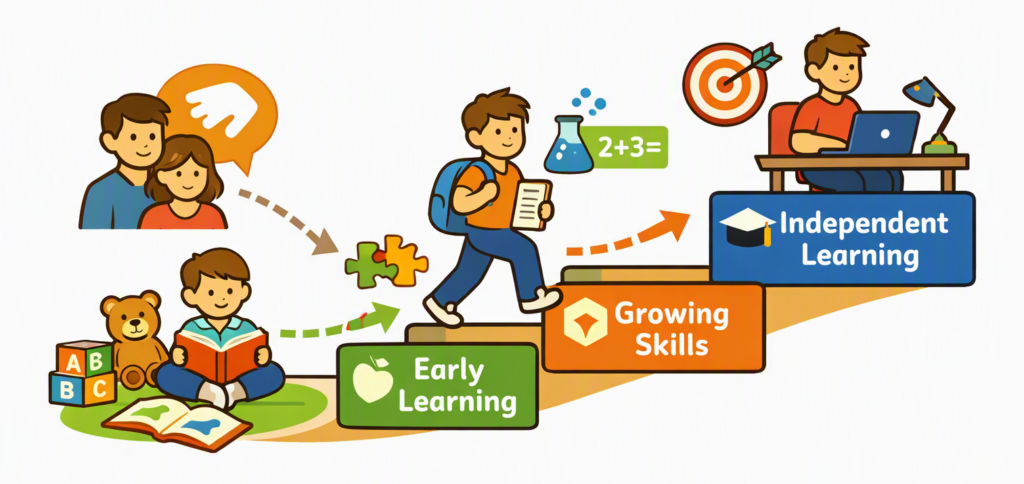
This creates an important challenge for parents: how can you adjust your support as your child becomes a more capable learner?
The answer is not simply to increase the amount of work or expect children to become independent at a particular age. It is to recognise how their learning needs are changing and provide the right balance of guidance, practice, and responsibility.
Understanding this progression can help parents make more appropriate decisions about home learning.
Learning Needs Are More Than Academic Ability
When parents think about a child’s learning, they often focus on what the child knows.
Can the child read a passage? Solve a maths problem? Remember a spelling rule? Understand a science concept?
These are important questions, but they do not tell the whole story.
Children also need to develop the skills that help them learn effectively. Depending on their stage of development, they may need support with:
- Understanding instructions.
- Maintaining attention.
- Remembering information.
- Beginning and completing tasks.
- Organising materials and time.
- Handling frustration.
- Choosing suitable learning strategies.
- Recognising mistakes and checking work.
- Deciding when to ask for help.
A child may understand a concept but still need help organising the steps required to complete an assignment. Another may be able to work independently in a familiar subject but need considerable guidance when learning something new.
Academic knowledge and learning independence develop together, but they are not the same thing.
Parents benefit from considering both when deciding what support a child needs.
Early Learning: Build Understanding Through Experience
Young children generally need learning experiences that are concrete, manageable, and connected to the world around them.
At this stage, children are developing basic academic skills alongside their ability to follow instructions, maintain attention, communicate their understanding, and manage simple tasks.
Parents can support early learning through activities such as:
- Reading together and discussing stories.
- Counting everyday objects.
- Sorting objects by shape, size, or colour.
- Exploring simple puzzles.
- Talking about everyday observations.
- Practising basic skills through play and repetition.
For example, a child learning to count does not need to rely exclusively on written exercises. Counting pieces of fruit, toys, or steps can connect numbers with quantities the child can see and handle.
Young children also benefit from clear instructions and help getting started. A long list of directions may be difficult to manage, whereas one or two steps at a time can make an activity easier to understand.
Parents should avoid treating early academic speed as the main measure of progress. Developing understanding, curiosity, communication, and positive learning habits provides a useful foundation for later learning.
For practical guidance, see article on “How to Choose the Right Learning Activities for Your Child’s Age.”
As Children Grow: Build Stronger Learning Habits
As children gain experience, they can gradually take on more structured learning activities.
They may become better able to follow instructions, complete familiar tasks, and remain engaged for longer periods. However, these abilities do not develop at the same rate for every child or in every situation.
Parents can begin to introduce more responsibility while maintaining a predictable learning routine.
For example, a child who previously needed a parent to prepare every activity might begin gathering their own books and stationery. A child who needed frequent reminders to return to a task might begin following a simple checklist.
These small responsibilities help children practise the practical skills involved in learning independently.
At this stage, parents can also help children develop a more consistent approach to practice. Rather than expecting a child to rely on motivation alone, they can establish manageable routines and clear expectations.
See article on “How Children Develop Strong Learning Habits: A Parent’s Guide” for more on building habits that support learning over time.
Older Children: Develop Planning and Problem-Solving Skills
As academic work becomes more complex, knowing the subject matter is only part of the challenge.
Children may need to complete longer assignments, manage several steps, remember earlier learning, and apply familiar knowledge to unfamiliar questions.
These tasks require stronger planning and problem-solving skills.
Parents can help by encouraging children to think through their work before beginning.
For example, if a child has to write a report, the parent might ask:
- What do you need to find out?
- What information will you need?
- Which part should you start with?
- How much time might the task require?
- How will you check whether the report is complete?
Initially, the parent may need to work through these questions with the child. As the child becomes more capable, the parent can allow them to create their own plan.
The purpose is not to remove all difficulty. It is to help children learn how to approach increasingly demanding work.
For a related guide, see article on “Why Planning and Time Management Skills Are Essential for Academic Independence.”
Teenagers: Support Greater Responsibility Without Withdrawing Support
Teenagers may be capable of managing much more of their learning independently, but greater capability does not mean that they no longer need guidance.
As schoolwork becomes more demanding, teenagers may need to manage competing deadlines, plan revision, identify gaps in their understanding, and decide which topics require additional practice.
Parents can support this transition by discussing expectations and helping teenagers develop realistic plans without controlling every study decision.
For example, instead of deciding exactly what a teenager must study each evening, a parent might ask:
“What assessments or deadlines are coming up, and how are you planning to prepare for them?”
The teenager can then suggest a plan, identify potential difficulties, and adjust it when necessary.
Parents should still be available when a teenager encounters a problem they cannot resolve independently. The aim is to transfer responsibility gradually, not to leave the teenager to manage every challenge alone.
The balance between guidance and independence is explored further in article on “How to Build Learning Independence in Children (Without Pressure).”
Why Age Alone Is Not Enough
Age provides a general indication of development, but it does not tell parents exactly what an individual child is ready to do.
Two children of the same age may have different strengths, experiences, and support needs.
Even the same child may demonstrate different levels of independence across subjects.
For example, a child might organise reading activities independently but need help planning a longer writing assignment. They may understand multiplication confidently but struggle to apply it to word problems.
These differences do not necessarily mean that the child is behind overall. They indicate that learning skills develop unevenly.
Parents should therefore consider three things together:
- Age and development: What kinds of tasks are generally appropriate?
- Current ability: What can the child already understand or do?
- Level of support required: What assistance helps the child make progress?
This gives parents a more useful basis for choosing learning activities than relying on age alone.
Recognise When Your Child Is Ready for More Responsibility
Children benefit from opportunities to take on new responsibilities, but these should be introduced gradually.
Look for signs that your child can manage a particular task with less assistance.
For example, the child may:
- Understand the instructions without repeated explanations.
- Begin a familiar task after a single reminder.
- Prepare the materials they need.
- Complete several steps in the correct order.
- Notice when they are stuck.
- Check their work before asking for help.
When these abilities become more consistent, parents can try reducing one form of support.
A parent who previously explained every step might begin asking the child to suggest the next step. A parent who checked every answer might ask the child to review the work first.
If the child struggles, the parent can restore some guidance and try again later.
This approach allows independence to grow without expecting children to manage responsibilities they are not yet ready for.
Adjust Support When Learning Becomes Difficult
Sometimes a child’s learning needs change because the work has become more challenging.
A child who completed earlier tasks confidently may begin struggling when new concepts require more complex reasoning or combine several skills.
Parents should avoid assuming that the child has become lazy or lost the ability to learn.
Instead, investigate the difficulty.
Ask:
- Does the child understand the instructions?
- Are there earlier concepts they have not fully understood?
- Is the task too large or complicated to manage at once?
- Does the child know how to approach this type of problem?
- Are they becoming frustrated before they can make progress?
The answers can help parents identify what kind of support is needed.
For example, a child who struggles with a long assignment may benefit from dividing it into smaller steps. A child who cannot explain a maths solution may need to revisit the underlying concept before attempting more questions.
When difficulties persist despite reasonable support, parents may need to discuss the situation with the child’s teacher or seek additional educational guidance.
Avoid Expecting Independence in Every Area at Once
One common mistake is to assume that a child who can work independently in one situation should be able to do so everywhere.
Independence depends partly on familiarity, task difficulty, confidence, and the skills required.
A child might manage a familiar reading routine without help but need guidance when analysing an unfamiliar text.
A teenager might plan revision independently for a familiar subject but need assistance organising a demanding project.
Parents should focus on the particular skill that needs development rather than judging the child’s overall independence from one difficult experience.
Choose one manageable area for improvement. Give the child opportunities to practise it, then review whether less support is becoming possible.
This makes progress easier to recognise and reduces unnecessary conflict around learning.
How Parents Can Adjust Their Approach Over Time
The following framework can help parents decide how to respond as their child develops.
| When the child needs… | Parents can… |
|---|---|
| Help understanding a new concept | Explain it, demonstrate examples, and check understanding |
| Support beginning a task | Clarify the first step and establish a simple starting routine |
| Help managing a larger assignment | Break it into manageable stages and plan the order |
| Guidance when a problem arises | Ask what the child has tried and discuss possible approaches |
| More responsibility for familiar work | Let the child plan, complete, and review the task |
| Support with an unfamiliar challenge | Provide guidance while allowing the child to do the parts they can manage |
This is not a rigid sequence. Parents may need to move between these approaches depending on the task.
The central principle is to provide enough support for the child to make progress while preserving opportunities to think, practise, and make decisions independently.
Final Thoughts
Children’s learning needs change as their knowledge, abilities, and experience develop.
Young children may need concrete experiences, clear instructions, and help getting started. Older children may need more support with planning, problem-solving, and applying knowledge. Teenagers may be ready to manage more of their learning, while still benefiting from guidance when work becomes demanding.
Parents do not need to predict every developmental change in advance.
They need to observe what their child can do, recognise where support is still necessary, and adjust their approach as the child develops.
The goal is not to expect children to become independent at a particular age. It is to help them build the skills and confidence to take increasing responsibility for their learning.
Effective support changes as children grow: parents guide where needed, allow independence where possible, and help children develop the next skill when they are ready.