Every parent wants their child to become a capable learner. But what does that actually involve?
Independent learning is not simply a child sitting alone, completing homework, or following a study timetable without reminders. A child can do all these things and still struggle to recognise when they do not understand something, decide how to approach a difficult task, or work out what to do next.
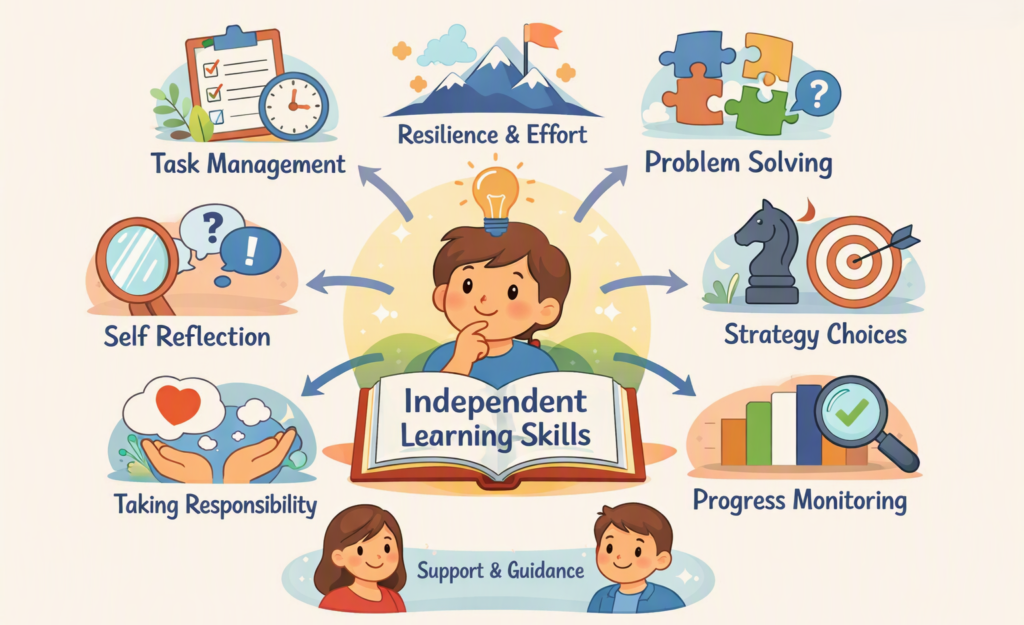
True learning independence involves several connected skills. Children need to develop learning habits, manage tasks, handle difficulties, choose appropriate strategies, monitor their progress, and gradually take responsibility for their own learning.
These abilities do not develop all at once.
Parents can help by understanding the different parts of independent learning and supporting children at the stage they are ready for.
What Does Independent Learning Really Mean?
Independent learning means being increasingly able to take responsibility for the learning process.
An independent learner can gradually learn to:
- Understand what they need to learn.
- Begin a task without constant reminders.
- Organise their time and materials.
- Choose a suitable way to approach a task.
- Keep working when something becomes difficult.
- Recognise when they are confused.
- Check their work and monitor progress.
- Ask for help when they need it.
- Decide what to do next.
Children do not need to master all these skills before they can be considered independent learners.
A child might organise their materials confidently but still need help managing frustration. Another might solve problems independently but struggle to begin tasks on time.
Independence develops unevenly. The aim is to help children strengthen the skills they need, one step at a time.
For a more detailed introduction, see article on “How to Build Learning Independence in Children (Without Pressure).”
Step 1: Build Consistent Learning Habits
Before children can manage their learning independently, they need a manageable starting point.
Predictable routines, suitable learning environments, and realistic expectations help children understand when learning takes place and what is expected of them.
This does not mean every day must follow a rigid timetable. Family life changes, and children have different needs.
The important thing is to establish a routine that is practical enough to maintain.
Parents can begin by:
- Choosing a reasonably consistent time for learning.
- Preparing the materials children are likely to need.
- Keeping learning sessions appropriate to the child’s age and concentration.
- Allowing breaks when necessary.
- Making expectations clear without turning learning into a daily struggle.
Children also need time to develop concentration, persistence, and the ability to return to a task after a distraction.
These habits provide a foundation for more advanced skills.
You can explore this further in article on “How Children Develop Strong Learning Habits: A Parent’s Guide.”
Step 2: Help Children Learn to Start and Manage Tasks
Knowing what needs to be done does not automatically mean a child knows how to get started.
Some children delay beginning a task because they are unsure what to do first. Others become overwhelmed by the amount of work in front of them.
Task initiation, organisation, and time management help children turn an intention into action.
Parents can support these skills by helping children:
- Identify the first action required.
- Prepare the necessary materials.
- Estimate how much time a task may take.
- Break a large assignment into smaller parts.
- Decide which task to complete first.
- Notice when they need a break.
At first, parents may need to guide children through these decisions. Over time, they can encourage children to make more of the decisions themselves.
For practical guidance, see article on “Why Task Initiation Is the Missing Link in Academic Independence” and article on “Why Planning and Time Management Skills Are Essential for Academic Independence.”
Step 3: Develop the Ability to Handle Difficulty
Independent learners do not find every task easy.
They encounter unfamiliar ideas, make mistakes, forget information, and sometimes feel frustrated.
The important difference is how they respond.
A child who immediately gives up may need help learning how to approach a difficulty. A child who continues repeating the same unsuccessful action may need help recognising that a different approach is required.
Parents can encourage children to:
- Identify exactly what they find difficult.
- Try a manageable next step.
- Consider a different way to approach the problem.
- Learn from mistakes without treating them as personal failures.
- Ask a specific question when they become stuck.
This does not mean children should struggle indefinitely. Parents should provide appropriate help when a child is distressed, confused, or unable to make progress.
The goal is to help children develop confidence in their ability to respond to difficulties, while knowing that support remains available.
For related guidance, see article on “Why Some Children Avoid Difficult Tasks” and article on “How to Help Children Manage Frustration While Learning.”
Step 4: Teach Children to Think About Their Own Learning
As children gain experience, they can begin to take a more active role in deciding what they want to improve.
Instead of simply completing whatever task an adult assigns, a child can learn to identify a learning need, set a realistic goal, and decide what action might help.
For example, a child may recognise that they understand a maths topic but frequently make mistakes when solving problems involving fractions.
With guidance, the child can set a specific goal, such as practising a few fraction problems and identifying which steps remain confusing.
Parents can encourage this thinking by asking:
- What are you trying to learn?
- Which part do you already understand?
- Which part needs more practice?
- What would help you improve?
- How will you know whether you are making progress?
These questions help children become more aware of their own learning rather than relying entirely on adults to identify every next step.
This builds on article on “How Children Learn to Set Goals for Their Own Learning.”
Step 5: Help Children Choose Suitable Learning Strategies
Once children understand what they want to learn, they need to consider how to approach it.
Different learning tasks may require different strategies.
A child learning new vocabulary might practise recalling word meanings. A child trying to understand a science process might benefit from drawing a diagram. A child struggling with a maths problem might need to examine an example before attempting another problem independently.
Parents can help children consider which approach suits the task.
If a strategy does not help, children can learn to review the difficulty and try a different approach.
They should not assume that every difficult task means they lack ability. Sometimes they need more practice; sometimes they need a clearer explanation or a different method.
This is an important step towards becoming a flexible learner.
For more detail, see article on “How Children Learn to Choose the Right Learning Strategies.”
Step 6: Teach Children to Monitor and Check Their Progress
Completing a task does not always mean a child understands what they have learned.
Children need opportunities to check whether they can remember information, explain an idea, or apply a skill independently.
For example, after reading a passage, a child might explain its main idea without looking at the text. After solving a maths problem, they might check the calculation or try a similar problem.
Parents can encourage children to ask themselves:
- Do I understand what I have done?
- Can I explain how I reached this answer?
- Which part did I find difficult?
- What should I review?
- What can I do independently now?
These questions help children recognise both progress and areas that still need attention.
Monitoring progress and checking completed work are related, but they are not identical. Monitoring helps children recognise how their learning is going; checking work helps them examine the accuracy or quality of what they have produced.
Explore these skills in article “How Children Develop Self-Monitoring Skills While Learning” and article “How Children Learn to Check Their Own Work Independently.”
Step 7: Help Children Recognise When to Ask for Help
Independent learning does not mean learning without assistance.
In fact, knowing when to seek help is an important part of independence.
A child may need help when an explanation is unclear, a problem involves a concept they have not learned, or repeated attempts have not resolved the difficulty.
Parents can help children distinguish between a task they can continue working on and one where guidance would be useful.
They can also teach children to explain what they have already tried and identify the specific part they do not understand.
For example, instead of saying, “I can’t do this,” a child might learn to say:
“I understand the first step, but I don’t understand why I need to change the denominator.”
That question gives the parent a clearer starting point for helping.
See article on “How Children Learn When to Ask for Help During Learning” for a closer look at this skill.
Step 8: Gradually Transfer Responsibility to the Child
The purpose of supporting independent learning is not to make parents unnecessary. It is to help children become increasingly capable of managing more of the learning process themselves.
At first, a parent might choose the task, explain the steps, and help the child check the result.
Later, the parent might ask the child to suggest a plan, identify the difficult parts, and decide how to review the work.
Eventually, the child may be able to manage familiar tasks independently while seeking guidance for unfamiliar or more challenging ones.
Parents can gradually step back by:
- Asking before giving an answer.
- Allowing children to make reasonable decisions.
- Encouraging them to explain their approach.
- Giving feedback without taking over.
- Offering more help when a task genuinely requires it.
The level of responsibility should match the child’s development, experience, and the difficulty of the task.
Some children will need more guidance in certain areas than others. That is normal.
How Can Parents Tell Whether Their Child Is Progressing?
Progress towards independence is not measured only by grades or the amount of work completed.
Look for changes in how the child approaches learning.
For example, the child may begin to:
- Start familiar tasks with fewer reminders.
- Prepare materials without being prompted.
- Explain what they need to learn.
- Try a reasonable strategy when stuck.
- Recognise when they have made a mistake.
- Check their work before asking an adult to review it.
- Ask more specific questions.
- Suggest what they should practise next.
These changes may appear gradually. A child may demonstrate a skill one day and need reminders the next.
Rather than expecting steady progress in every area, notice which skills are becoming more consistent and where additional support is still needed.
What Should Parents Work on First?
It is tempting to try to improve every learning skill at once. That can make learning more complicated for both parents and children.
A more practical approach is to identify one current difficulty.
If a child regularly delays beginning tasks, start with task initiation.
If a child begins readily but becomes overwhelmed by longer assignments, work on breaking tasks into smaller steps.
If a child completes work but cannot explain what they learned, focus on understanding and checking progress.
If a child repeatedly struggles without asking for help, teach them how to recognise confusion and ask specific questions.
Choose a skill that would make a meaningful difference to the child’s current learning experience. Practise it in ordinary situations before adding another priority.
This allows the child to build on existing abilities rather than being overwhelmed by too many new expectations.
Final Thoughts
Independent learning is not a single skill that children suddenly acquire. It develops through a combination of habits, practical skills, thinking strategies, and gradually increasing responsibility.
Children need opportunities to learn how to begin tasks, organise their work, handle difficulties, choose appropriate strategies, monitor progress, and seek help when necessary.
Parents play an important role in this process. They provide structure, demonstrate useful approaches, offer guidance, and gradually allow children to make more decisions for themselves.
The aim is not to make children independent as quickly as possible.
It is to help them become capable learners who understand their own needs, know how to respond to challenges, and can increasingly take responsibility for what they learn.
Independence grows when children are given the right support, meaningful opportunities to practise, and enough time to develop the skills they need.