Many parents feel a strong desire to support their child’s learning but are often overwhelmed by the uncertainty of what is truly appropriate for different age groups.
In an era of information overload, it is common to worry about the balance between academic enrichment and burnout. The reality is that impactful learning does not require an exhaustive curriculum. When educational experiences are thoughtfully tailored to a child’s unique stage of development and natural curiosities, they become significantly more effective and enjoyable for the whole family
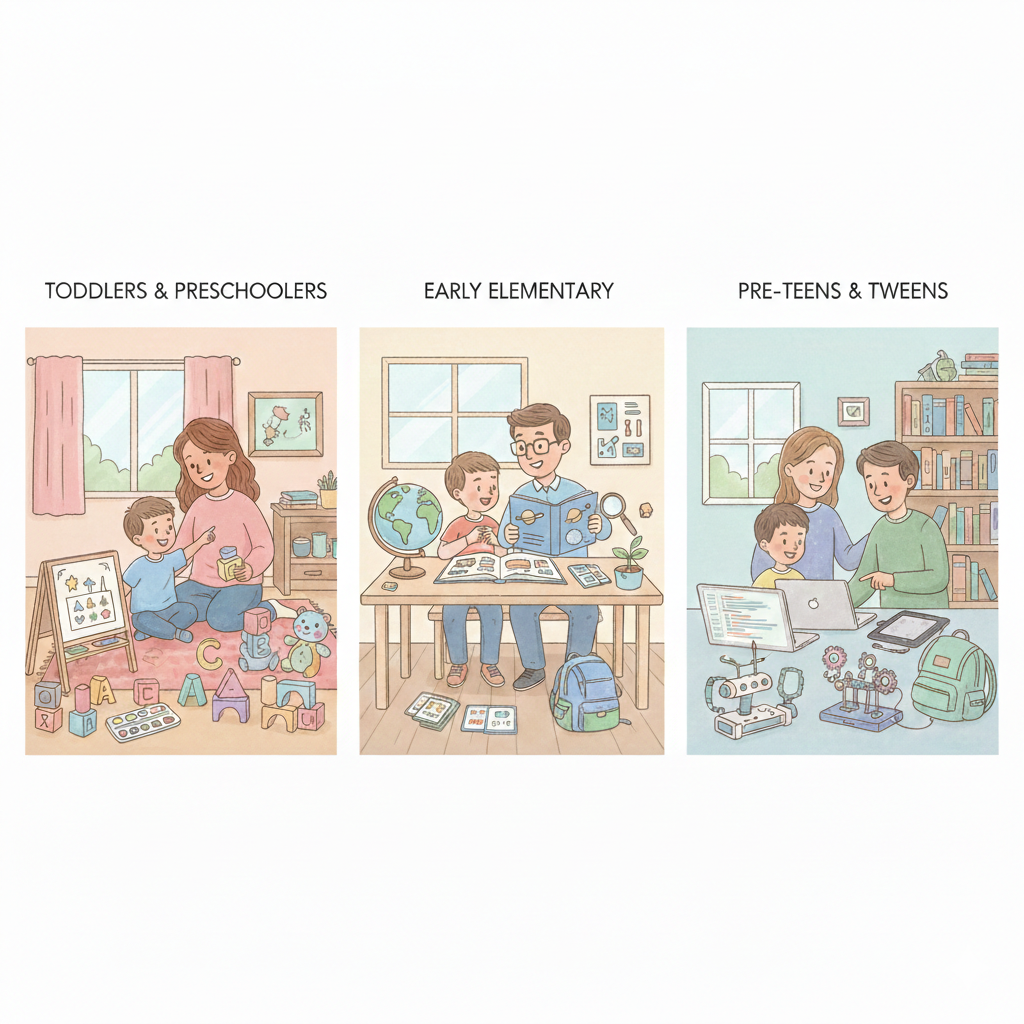
Why Age Matters (But Isn’t Everything)
A child’s age can offer helpful guidance when choosing learning activities, as it often reflects general developmental readiness. Attention span, motor skills, and emotional maturity tend to grow over time.
However, age alone shouldn’t dictate every choice. Children develop at different paces, and interests often matter more than numbers. Observing how your child responds to activities gives better insight than following age labels too closely. For example, two children of the same age may enjoy very different activities; one might prefer drawing quietly, while another learns best through movement and play.
Learning Activities for Younger Children
For younger children, learning happens best through play and exploration. Activities should be simple, hands-on, and short, allowing them to move freely between tasks without pressure.
Songs, storytelling, sorting objects, and pretend play all support early learning naturally. The focus should be on curiosity and enjoyment rather than outcomes. For example, counting toys during clean-up or naming colors while drawing helps children learn without feeling like they are being taught.
Learning Activities for Older Children
With increased maturity comes a readiness for more sophisticated, project-based learning. Rather than brief, isolated tasks, older children can tackle activities that bridge several days, such as writing and illustrating a short story or conducting a week-long science experiment. The key to engagement at this stage lies in ‘structured choice’: defining the boundaries of the task while giving the child the final word on the details. This approach not only clarifies expectations but also validates the child’s agency, leading to a more profound investment in the learning process.
A practical example is involving a child in a ‘real-world’ problem, such as planning the logistics of a family garden; they must research plant types, calculate space, and manage a schedule. When parents set the ultimate objective but grant the child the freedom to navigate the obstacles, they create an environment where the child feels both supported and empowered
Let Your Child’s Interests Guide You
Interest is one of the strongest drivers of learning. When activities connect to what your child already enjoys, learning feels meaningful rather than forced.
Pay attention to recurring interests and adjust activities accordingly. Over time, you can gradually increase complexity while keeping motivation high. Exploring different learning resources for home learning can also help you discover ideas that align with your child’s curiosity. For example, if your child enjoys animals, reading animal stories, drawing pictures of animals, or watching nature documentaries together can all support learning.
Final Thoughts
There is no perfect formula for choosing learning activities by age. What matters most is staying attentive, flexible, and responsive to your child’s needs with the passage of time.
By combining age awareness with observation and interest-led choices, you can create a learning experience that grows naturally over time. When paired with a simple home learning routine, these choices become easier to sustain and more rewarding for both parent and child.