When adults observe young children learning, repetition often appears unnecessary. A child may request the same story repeatedly, return to the same activity, or revisit a concept that already seems familiar.
From an adult perspective, this can feel redundant.
From a developmental perspective, repetition is one of the most important mechanisms through which young children learn.
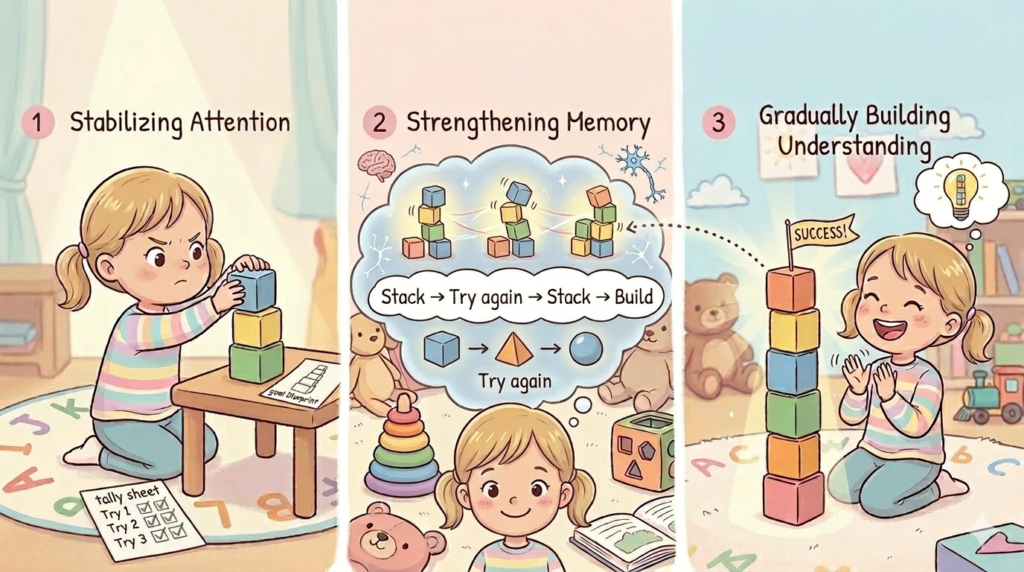
Repeated exposure allows children to stabilize attention, strengthen memory, and gradually build understanding.
Repetition Builds Cognitive Stability
Young children are still developing the mental systems required for learning.
Each repeated experience allows the brain to strengthen connections related to:
- attention
- recognition
- memory retrieval
- pattern understanding
When children repeat an activity, they are not simply revisiting the same experience. They are refining their ability to process it.
This gradual strengthening creates the stability required for later academic learning.
Why Children Request the Same Activity
Parents often notice that children return to the same activity even after they have already experienced it many times.
Common examples include:
- asking for the same book every night
- repeating familiar counting games
- returning to the same puzzles or building activities
These repeated choices are not accidental.
Children tend to repeat activities that feel manageable while still offering small opportunities for discovery.
Repetition provides a balance between familiarity and exploration.
Repetition and Learning Habits
Repetition also supports the formation of consistent learning behaviors.
When children return to familiar activities, they practice:
- sitting with a task
- listening carefully
- completing an activity
- engaging for longer periods of time
Over time, these behaviors contribute to the development of early learning habits, which shape how children approach learning situations later in life.
Why Adults Sometimes Interrupt Repetition
Adults may unintentionally disrupt repetition by introducing new material too quickly.
This often happens when parents believe progress requires constant novelty.
However, introducing new activities too rapidly can have unintended consequences:
- attention becomes fragmented
- children feel less confident with unfamiliar tasks
- learning becomes more dependent on guidance
Allowing repetition gives children the time they need to consolidate learning.
The Relationship Between Repetition and Attention
Repetition also plays a role in the gradual development of attention.
When children encounter familiar material, they can focus more comfortably because the task is predictable.
This repeated engagement supports the early development of concentration skills, which later become essential for structured academic work.
Repetition Is Not Lack of Progress
It is easy to assume that repeating an activity means a child is not advancing.
Parents sometimes worry that repeated activities mean their child is not progressing, even when the child is actually getting enough learning at home.
In reality, repetition is often the mechanism through which progress occurs.
Each repeated encounter allows children to:
- notice new details
- strengthen memory
- increase confidence with the task
Learning becomes more secure when understanding is reinforced multiple times.
Supporting Repetition in Everyday Learning
Parents do not need to create complicated learning systems to support repetition.
Simple practices are usually enough:
- Allow children to repeat activities they enjoy.
- Avoid rushing to introduce new material.
- Observe whether engagement increases over time.
- Introduce variation gradually rather than abruptly.
These small adjustments help maintain a learning environment where repetition strengthens understanding.
A Natural Part of Early Learning
Repetition is not a limitation in early learning.
It is a fundamental part of how young children build knowledge.
When children have the opportunity to revisit ideas, activities, and routines, learning becomes more stable and more meaningful.
Over time, this stability supports the broader development of curiosity, attention, and confidence.