Children often believe that learning means reading something several times, copying notes, or spending more time studying.
These activities can sometimes help. However, not every learning method works equally well for every task.
A child who is trying to remember spelling words may need a different approach from a child who is learning how to solve a maths problem.
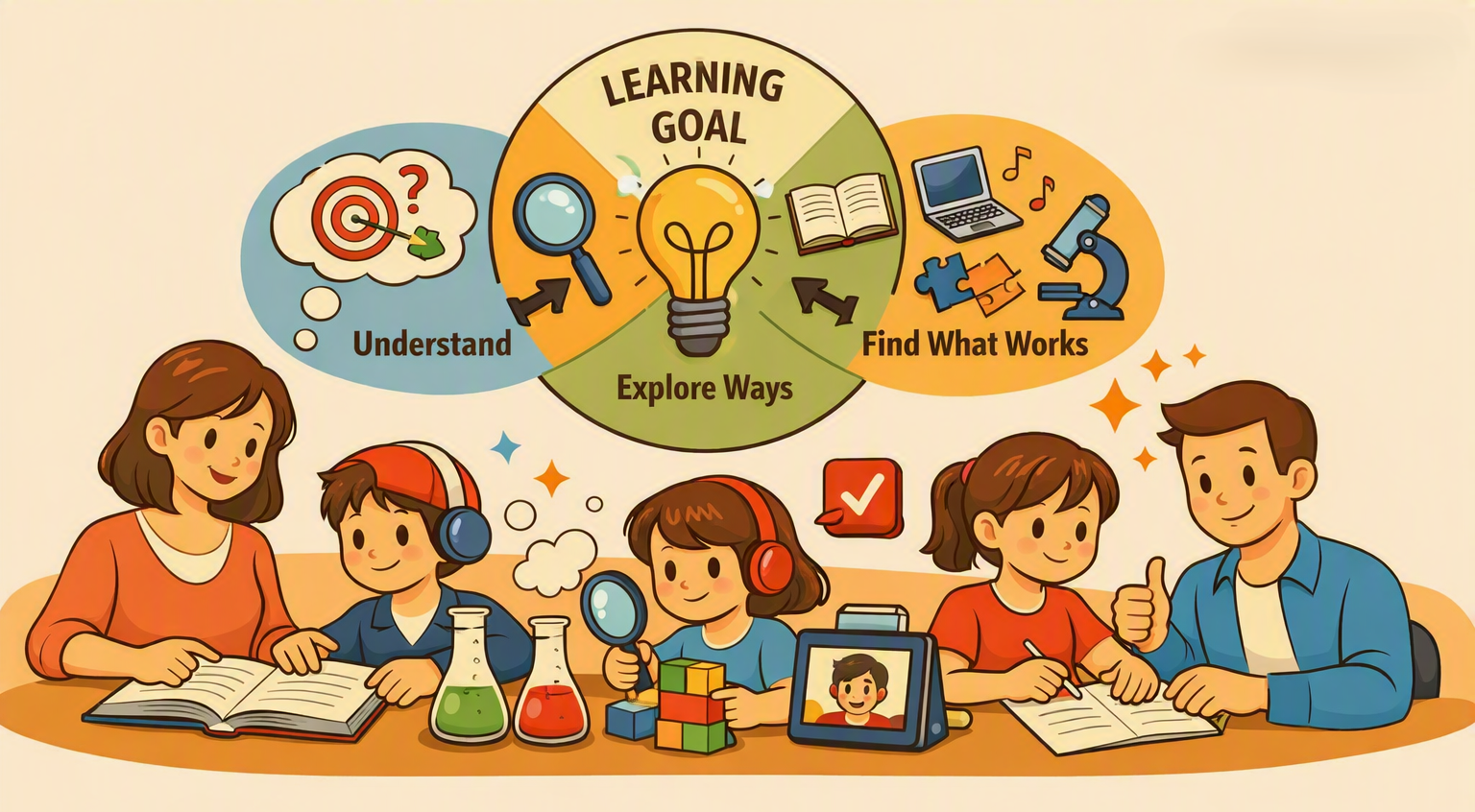
Learning to choose suitable strategies helps children become more flexible and independent learners.
Parents can support this development by helping children understand what they are trying to learn, explore different ways of learning, and notice which approaches help them make progress.
The aim is not to make children follow one perfect method. It is to help them learn how to choose and adjust their approach.
What Is a Learning Strategy?
A learning strategy is an action a child uses to help understand, remember, practise, or apply something.
Examples include:
- Reading a passage and explaining it in their own words.
- Practising spelling words from memory.
- Drawing a diagram to understand a science concept.
- Working through a maths problem step by step.
- Using examples to understand a new idea.
- Practising a skill several times and checking what needs improvement.
Different strategies serve different purposes.
For example, copying a multiplication table may help a child become familiar with it, but trying to recall the answers without looking can help them find out what they remember independently.
The useful question is not simply, “Did my child study?”
It is also:
“Was the method suitable for what my child needed to learn?”
Why Children Need to Learn How to Choose Strategies
Children do not automatically know which learning approach will help them.
They may continue using a familiar method even when it is not helping them understand.
For example, a child who struggles with a reading passage might keep reading the same paragraph repeatedly without stopping to identify what is confusing.
Another child might spend a long time copying notes but still find it difficult to explain the main ideas.
These children may be working hard. The difficulty is that they have not yet learned to choose a more useful approach.
Helping children select strategies can teach them to respond to learning difficulties with a plan rather than simply repeating the same action.
Start by Identifying What the Child Needs to Learn
Before choosing a strategy, children need to understand the learning task.
Ask a simple question:
“What are you trying to learn or improve?”
The answer helps determine which approach might be useful.
For example:
| Learning need | Possible strategy |
|---|---|
| Remember spelling words | Practise recalling words, then check them |
| Understand a difficult passage | Explain the main idea in their own words |
| Learn multiplication facts | Practise recalling answers and review difficult facts |
| Understand a science process | Draw and label a diagram |
| Improve writing | Plan, draft, and revise a short piece |
| Solve a maths problem | Work through the steps and explain the reasoning |
These are starting points, not fixed rules. Children may need to try different approaches to find what helps with a particular task.
Help Children Try More Than One Approach
When a child is struggling, parents may be tempted to explain the answer immediately or tell the child exactly what to do.
Sometimes direct help is necessary. But when appropriate, give the child an opportunity to consider another approach.
For example:
Child: “I keep forgetting these spelling words.”
Parent: “What have you tried so far?”
Child: “I keep reading them.”
Parent: “Would you like to try covering the words and spelling them from memory, then checking which ones you missed?”
This introduces another strategy without suggesting that the child has done something wrong.
The child can then compare the approaches and notice whether one helps them identify what they remember and what still needs practice.
Show Children That Different Tasks Need Different Strategies
One learning method will not be suitable for every subject or task.
A child may need to practise recalling information when learning vocabulary. For a difficult concept, however, they may first need an explanation, an example, or a diagram.
Parents can make this distinction clear through everyday learning.
Example: Learning vocabulary
A child is trying to remember the meaning of five new words.
They could:
- Read each word and its meaning.
- Cover the meanings.
- Try to explain each word.
- Check which meanings they remembered.
- Practise the words that remain difficult.
Example: Understanding a maths concept
A child is learning how fractions work.
They might need to:
- Look at a visual example.
- Discuss what the parts represent.
- Work through a simple problem.
- Explain why the answer makes sense.
- Try another problem independently.
The two tasks require different approaches because the learning needs are different.
Encourage Children to Explain Why They Chose a Strategy
Children can begin to develop more thoughtful learning habits when they can explain why they selected a particular approach.
Parents can ask:
- “What are you trying to learn?”
- “Why did you choose this method?”
- “How do you think it will help?”
- “What will you do if it does not help?”
- “How will you check whether you understand?”
These questions do not need to become a long discussion.
A brief conversation can help a child connect the learning task with the method they choose.
The goal is to develop thoughtful decision-making, not to make children justify every action.
Teach Children to Change Their Approach When Needed
Sometimes a strategy does not help as much as expected.
A child may reread a passage but still be unable to explain it. They may practise a maths problem repeatedly but continue making the same mistake.
This is an opportunity to learn that continuing with the same method is not always the best response to difficulty.
Parents can ask:
“What is still confusing?”
Then help the child consider a different approach.
For example, the child might:
- Break the task into smaller parts.
- Look at a worked example.
- Draw a picture or diagram.
- Explain the problem aloud.
- Try a simpler question first.
- Ask for help with the specific part they do not understand.
For more on this related skill, see earlier article, How Children Learn to Break Down Difficult Tasks Into Smaller Steps.
Changing strategies is not giving up. It can be a sensible response when the current approach is not helping.
Connect Strategy Choice With Learning Goals
Children are more likely to choose a suitable approach when they have a clear learning goal.
For example, “I want to get better at maths” does not identify exactly what the child needs to do.
A more specific goal might be:
“I want to understand how to add fractions with different denominators.”
Once the goal is clear, the child and parent can consider which strategy might help.
They might use visual examples, work through guided problems, or practise explaining the steps.
This connects with previous article on How Children Learn to Set Goals for Their Own Learning, which explains how children can identify learning targets and gradually take greater responsibility for them.
The sequence is straightforward:
Identify a goal → choose an approach → practise → review progress → adjust if needed.
Help Children Notice Whether a Strategy Is Working
A child may feel that a learning method is helpful simply because it feels familiar or easy.
Parents can help children look for evidence of progress.
For example, after practising spelling words, the child might try to spell them without looking.
After reading a passage, the child might explain its main idea in their own words.
After solving a maths problem, the child might try a similar question independently.
These activities help children check whether they can actually remember, understand, or use what they have been learning.
This connects with article: How Children Develop Self-Monitoring Skills While Learning, which discusses how children learn to notice their own progress and recognise when they need to adjust.
Give Children Choices Without Removing Structure
Children benefit from having some control over how they learn, but too many choices can be confusing.
Instead of asking:
“How do you want to study everything today?”
a parent could offer two suitable options:
“Would you like to practise these words by writing them from memory or by saying them aloud and then checking?”
Both options can support the learning task.
As the child develops experience, parents can gradually offer more responsibility for choosing methods.
The amount of choice should match the child’s age, experience, and confidence with the task.
Common Mistakes Parents Make
Insisting on one method for every task
A method that helps with vocabulary may not be suitable for understanding a complicated concept.
Help children consider what they are trying to learn before choosing an approach.
Changing methods too quickly
Children need enough time to try a strategy and see whether it helps.
Do not expect them to judge every method after one brief attempt.
Choosing the strategy for the child every time
Parents can demonstrate and guide, but children also need opportunities to make their own choices.
Treating difficulty as proof that the strategy has failed
Some learning tasks are difficult even when the approach is suitable.
Help children distinguish between needing more practice and needing a different method.
Focusing only on finishing the task
Completing an activity does not always mean the child understands or remembers what was taught.
Encourage children to check what they can explain, recall, or do independently.
Signs a Child Is Developing Strategy-Selection Skills
You may notice that your child begins to:
- Identify what they are trying to learn.
- Suggest different ways to approach a task.
- Explain why they chose a particular method.
- Recognise when a familiar approach is not helping.
- Try another method when appropriate.
- Check whether they can remember or apply what they learned.
- Ask for specific help when they become stuck.
These signs indicate that the child is beginning to make more thoughtful decisions about learning.
Progress will vary. Younger children may need frequent guidance, while older children may be able to make more of these decisions independently.
Final Thoughts
Becoming an independent learner involves more than completing work without assistance.
Children also need to learn how to decide what they are trying to learn and which approach may help them achieve it.
Parents can support this development by introducing suitable strategies, encouraging children to try different methods, and helping them notice whether those methods are working.
Over time, children can take greater responsibility for choosing and adjusting their own learning approaches.
The aim is not to find one perfect strategy for every situation.
It is to help children become flexible learners who can think about a task, choose a reasonable approach, and change direction when needed.